

In the South Hebron Hills of the occupied West Bank, the sun sets over the rolling hills of ancient Susiya, where the first rains have planted new life into the soil. Moussa and his wife, Amal, prepare for the nightly potential of an Israeli settler attack inside their self-made cell of iron fencing and barbed wire. The graceful inflections of the call to prayer can be heard faintly above the gentle winds but, as the sun sets over Moussa’s land, the twilight ushers in the terrible likelihood of violence here.

Sunset over the South Hebron Hills seen through the gate protecting Moussa’s land
“They make us imprison ourselves here,” Moussa says, closing and locking the gate to the family house. “They come every day now. Yawm yawm
[Every day].”
Moussa, South Hebron Hills
This self-imposed imprisonment is a matter of safety for Moussa, Amal, and their two-year old granddaughter, Hala, whose parents work away from their family home. But the three of them are secluded here, cleft between the Jewish-Israeli hilltop settlement of Susiya and the Palestinian city of Yatta.
One evening in January 2026, they ask us to stay with them as a ‘protective presence’ against the threat of settler violence. We stay with them until the following afternoon, when Moussa will be able to return from the mosque without fear that his wife and grandchild are left all alone.

Moussa in front of his olive tree orchard, South Hebron Hills
Protective presence is the practice of accompanying vulnerable Palestinians during their everyday lives in an effort to deter settler violence and provide a sense of security and international solidarity. The Ecumenical Accompaniment Programme in Israel and Palestine (EAPPI) has practiced this for nearly 25 years. However, as Israeli human rights activists have highlighted, the effectiveness of protective presence has become more limited, due to the impunity which Israeli settlers enjoy even after attacking and injuring internationals. Nonetheless, our presence provides a form of international solidarity recognised by the Palestinian communities. Moussa told us:
“We need internationals here with us. Everything is much worse since October 7.”
Moussa
Our protective presence at night will allow Moussa to sleep an extra few hours than he usually would be able to get. He told us that he usually sleeps only 1-2 hours each night. In the morning, we stay at home with his wife and granddaughter, so that he will be able to leave for a few hours and drive into the city of Yatta. There he will be able to worship at the mosque, and run important errands, like collecting medicine for his wife, and gather animal feed for his dwindling flock of sheep.

Moussa’s sheep in their pen
Moussa tells us a story about being attacked by an Israeli settler while out on his land with his sheep.
“Shoot me if you must,” he told the settler armed with an AR-15 rifle, “But this is my land”
Moussa
He further explained that he can no longer take his sheep out to graze the land because it’s just too dangerous. In May 2025, an Israeli settler attempted to attack his wife Amal with an all-terrain vehicle. Then the settler called out to Moussa by name to taunt him: “Where are you, Moussa? Where are you?”. He described feeling utterly powerless to stop the violence. This is a land where the oppressor and the oppressed are known to each other by their first names.

Storm clouds roll over the city of Yatta (in the distance) towards Moussa’s home
Moussa tells us about another attack, earlier in January 2026, when Israeli settlers in army uniforms from the Susiya and Ma’on Israeli settlements broke into his property, cutting the gate open, and confiscating his car he uses to collect medicine, animal feed, and visit family. We watch the CCTV footage of the incursion during which Moussa recounts how the Israeli settler beat him and threatened to return and “massacre them all” if the footage was ever shared (for that reason the footage is not available here). Moussa says that the Israeli settler attacks against his family are part of a deliberate and concerted attempt to create such a hostile environment for the Palestinians that they choose to leave.
When we asked him why he remains on the land in the face of all the violence he said:
“This is our land. How can I leave my land? If I leave the settlers will take it. We know the occupation wants us to leave, so they can take it. But if we leave, then we leave to our graves. We won’t leave here until we die. This is sumud. Do you know what that means? It means to be firm until the last breath.”
Moussa

Moussa
The fear of violence in South Hebron Hills is palpable, justified given the increasing frequency of attacks: in October 2025 the United Nations recorded the highest monthly number of Israeli settler attacks against Palestinians since documenting began in 2006 – with five Palestinian killed, including a child, in the span of a week (source: OCHA). More than 260 recorded settler attacks have resulted in physical harm to Palestinians, damage to Palestinian land and property, and on average eight incidents were recorded every single day in October 2025 alone.
Furthermore, the Israeli state is directly supporting the displacement of Palestinians by equipping settlers with weapons, as well as all-terrain vehicles and drones used to terrorise Palestinian communities.
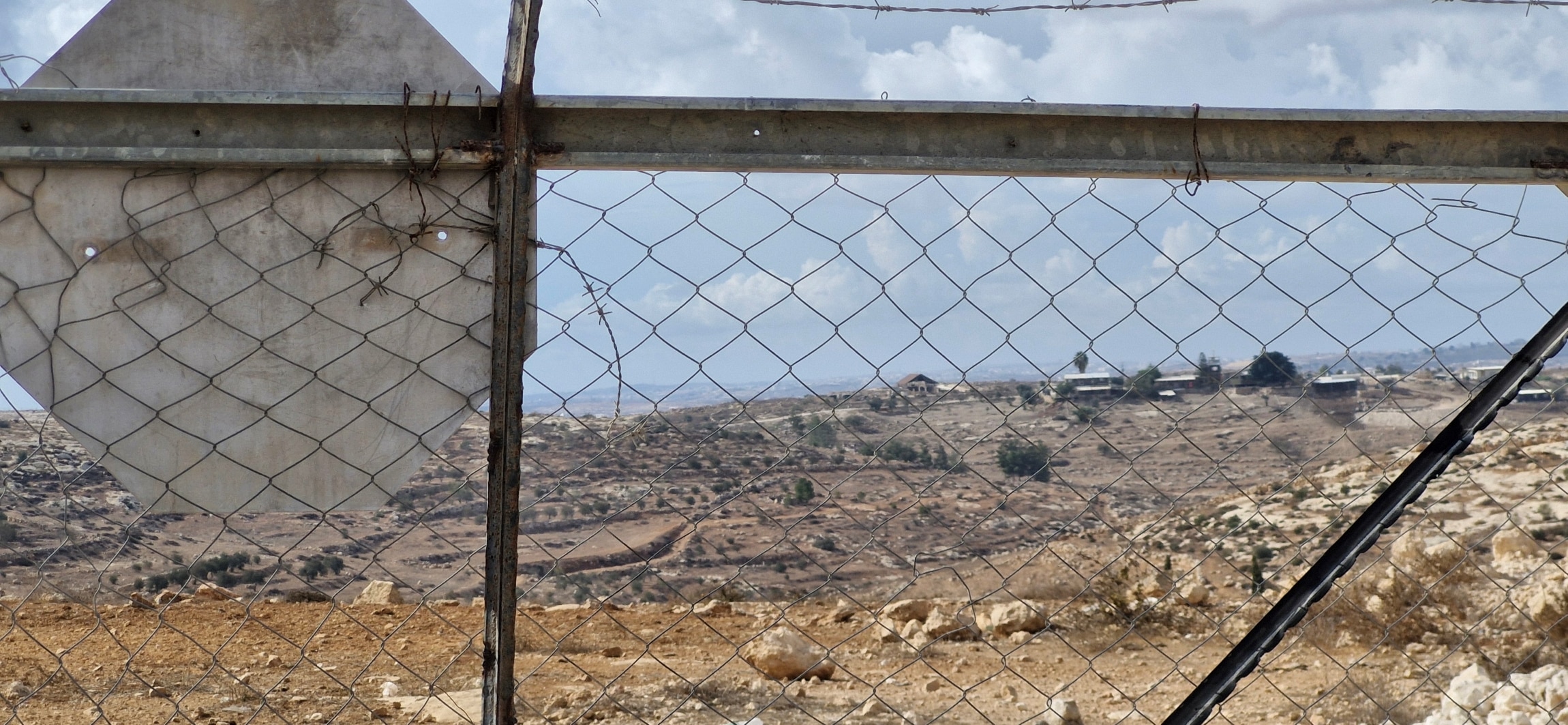
The illegal Susiya Israeli settlement outpost seen through Moussa’s fence
The Israeli government’s justification for supporting the settlers is based on an ideological doctrine of expansion, according to Finance Minister Bezalel Smotrich.
“[W]e are equipping these pioneers with the tools that will allow them to protect their homes, maintain the territory, and deepen our hold on the Land of Israel.”
Bezalel Smotrich, Israel’s Finance Minister
The euphemistic reference to ‘pioneers’, when referring to Israeli settlers in the West Bank, provides political cover for the violence perpetrated by settlers against Palestinian people. However, the equipment with which the settlers are provided is further endorsement for the settler violence done to Palestinian communities by the Israeli government.
According to the Israeli human rights organisation, B’Tselem, the collusion between Israeli settlers and their government has two key components: first, military orders, court orders, and other legal machinations to expel Palestinians from their land, and; second, but running concurrently, settler violence including the use of physical intimidation, harassment, and threat of violence against Palestinians, increasingly with the collusion and participation of state authorities, including the army. You can read more about the ‘blurred lines’ between settlers and soldiers, sometimes referred to as ‘settler-soldiers’ in the West Bank here.
Despite the violence done to him and his family, Moussa refers to the Jewish-Israeli settlers as “the cousins” when he speaks about them. This is a biblical allusion to the common Abrahamic roots of the semitic peoples in the Holy Land (which includes both Arabs and Jews). However, his granddaughter, Hala, who is just two years old, is terrified of the settlers. She hides when new people arrive at her grandparents’ home. Last November, during the olive harvest, a settler threw a stone that hit Hala in the eye. Despite her pain, Moussa felt powerless to seek any justice.

Moussa’s land in the sun
Now, whenever people come to visit her family, Hala refuses to go out to meet them because they could be ‘moustoutineen’ (the Palestinian word for settlers). Still, they remain steadfast on their land. Amal tells us:
“We won’t leave. The stones on this land are worth more than anything else in the world.”
Amal

The first rains fall over the South Hebron Hills, planting new life
Moussa asks us to record his words:
“Tell the world what is happening here in Palestine! Tell the people who care that Palestinians want to stay on our land. We don’t want violence. This is our home.”
Moussa
Take action
-
Share and discuss this blog with your friends and family.
-
Follow @nootherland.film and @shabab_of_susiya to receive updates directly from Palestinian activists in South Hebron Hills.
-
Email your elected representative to demand they stop trading with illegal settlements as a first step to end support for Israel’s illegal occupation:
The need for solidarity and accompaniment is more important than ever. We can’t do this without you. Your support helps us maintain a solidarity presence in Palestine and Israel — witnessing human rights abuses and walking alongside communities under threat. Donate today.
What does international law say?