

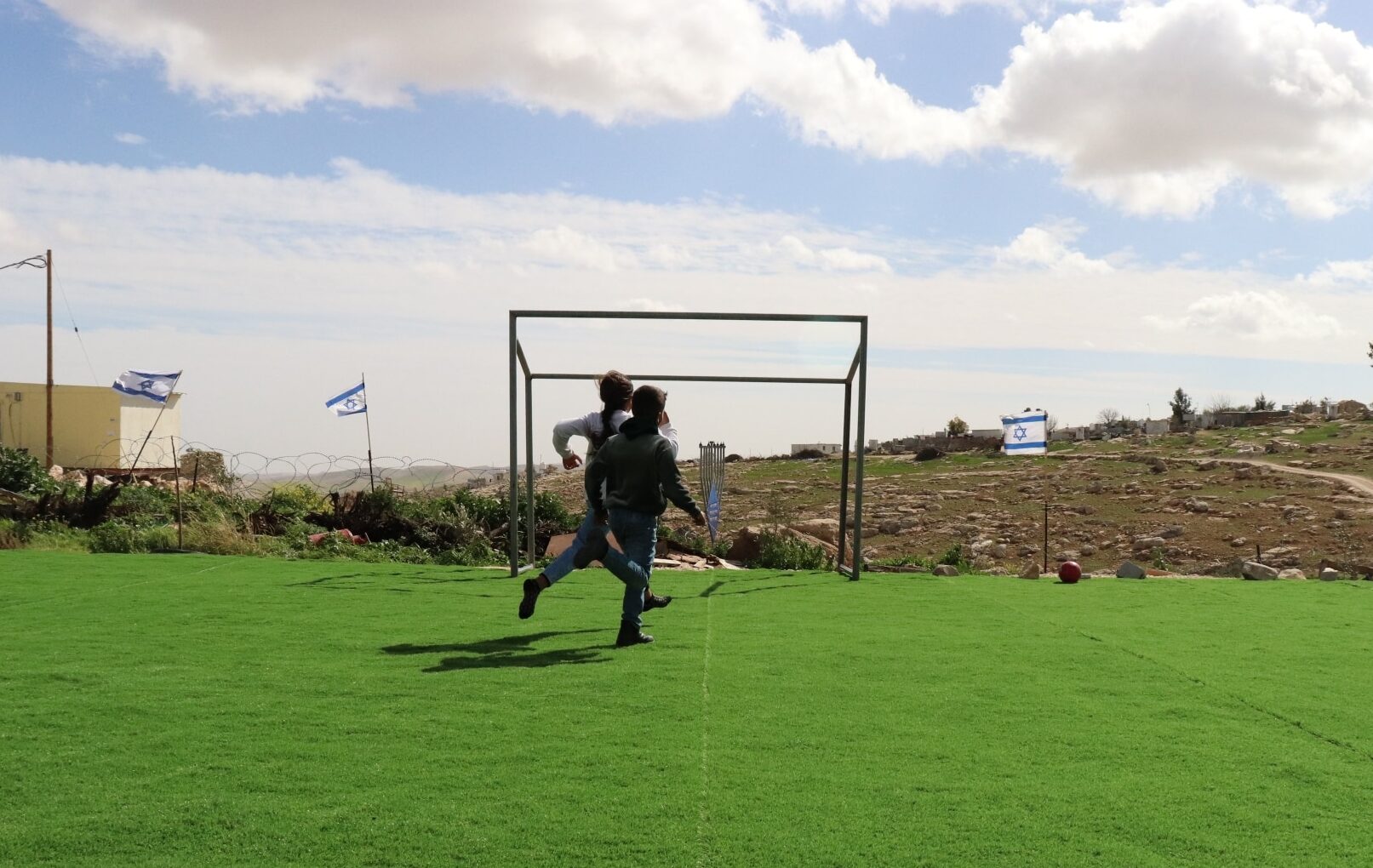
Children playing on Umm al-Khair’s football pitch
Under the glare of the midday sun, a clean right foot connects with the ball and seven children watch it sail into the top corner. I am playing football with the children of the Palestinian village of Umm al-Khair in the South Hebron Hills of the occupied West Bank.
The pitch was laid and named in honour of Awdah Hathaleen, community leader and beloved brother to Khalil Hathaleen, who was murdered by a known violent Israeli settler, Yinon Levi, while attempting to block the settler from illegally clearing olive trees and destroying water pipes on their village’s land. Three of the children running beside me are his.
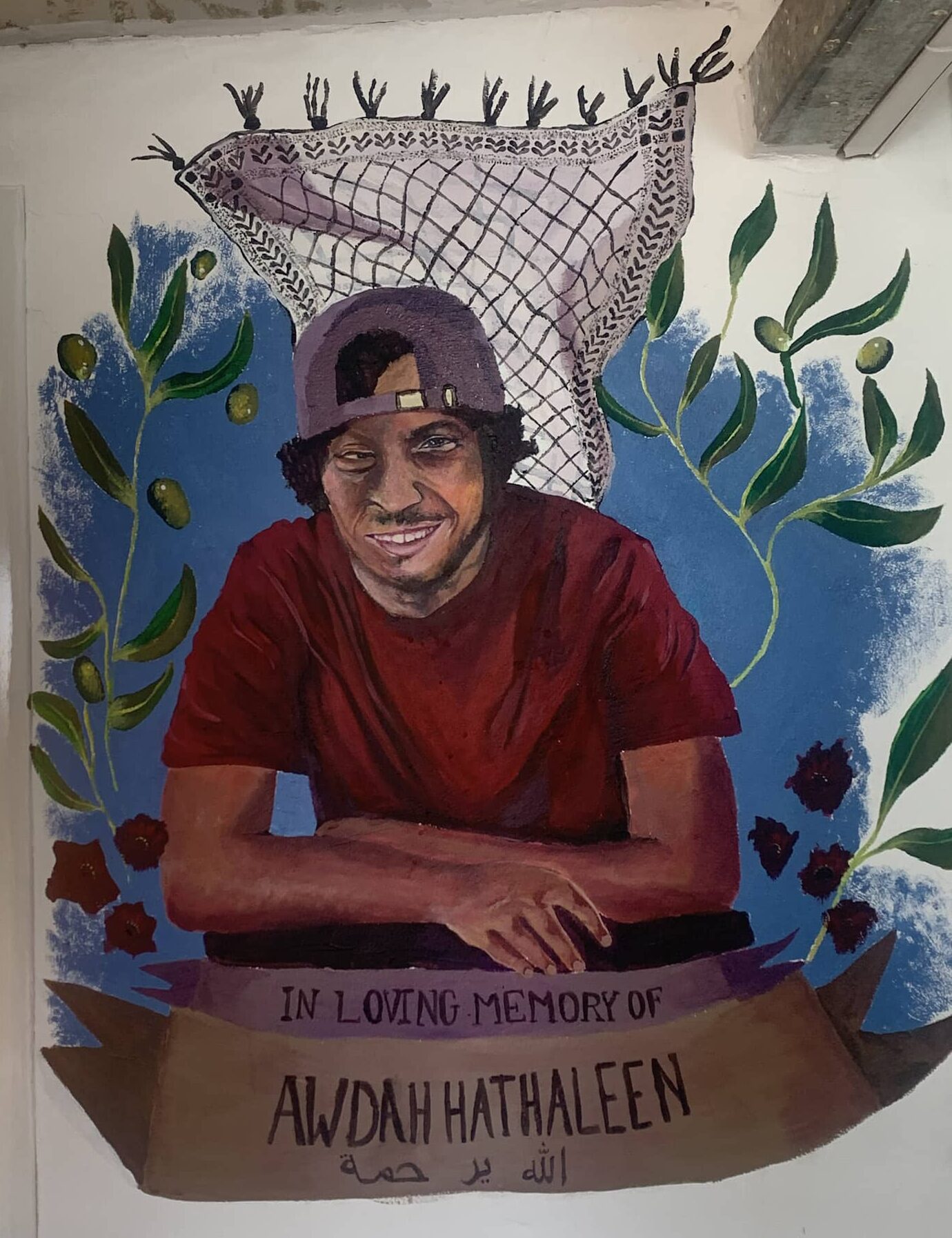
Awdah Hathleen mural in Umm al-Khair
Awdah’s dream was for a safe space for the children of his village to play, and so in his memory the community cleared and flattened the ground, upon which was placed bright green artificial grass to create a football pitch.
But from the moment it was created it has been threatened by Israeli settlers as well as the Israeli authorities. The pitch represents a microcosm of Israel’s occupation where even the right of children to play is targeted. Today, it is at risk of demolition and Khalil tells me that:
“Without international support there is little hope of protecting it.”
Khalil Hathaleen, community leader of Umm al-Khair and brother of Awdah
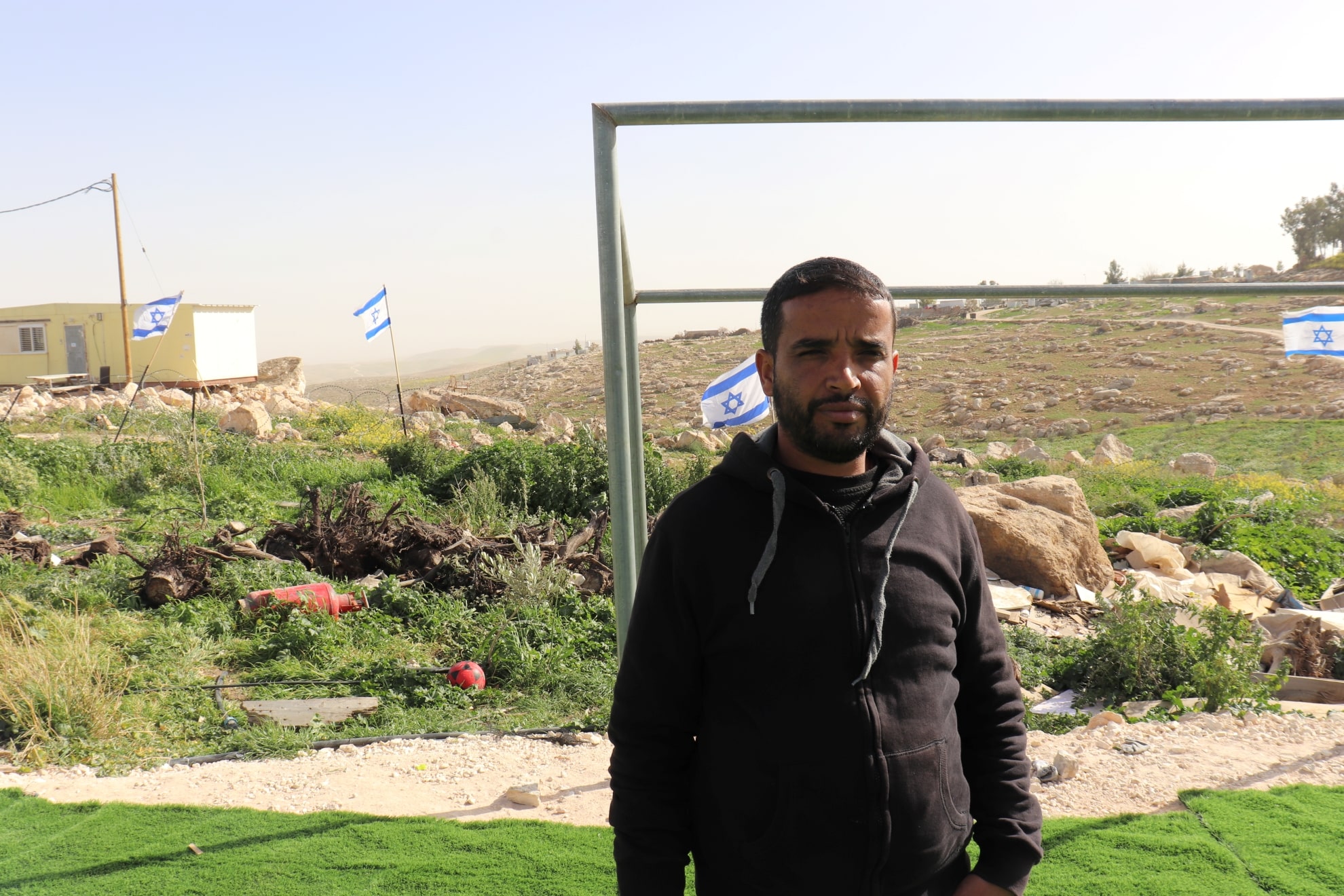
Khalil Hathaleen standing on the pitch with Israeli flags placed by settlers and settler caravan in the background
Umm al-Khair is one of 12 communities that make up Masafer Yatta, in the Israeli-controlled area of the West Bank known as Area C. The village is home to 37 Palestinian families or approximately 300 people.
The village, despite having been lived in by the same families for generations, is not recognised by the Israeli state, and so in the 1980s and 1990s the Israeli state declared the land as ‘state land’ and allocated it to Israeli settlers to build on illegally. Now, the small village of Umm al-Khair is nearly surrounded by the illegal Israeli settlement of Carmel which is now several times the size of it.
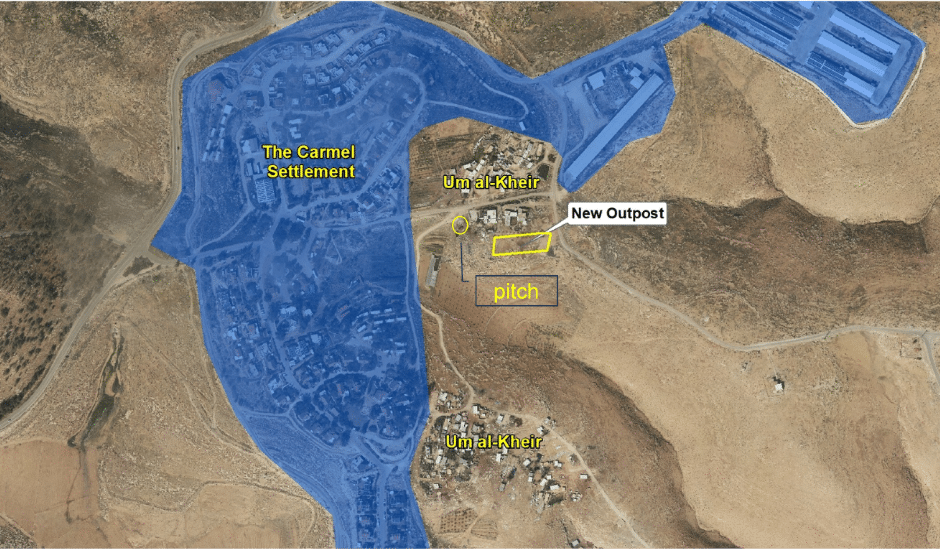
Map of Umm al-Khair and illegal Israeli settlement of Carmel, Source: Peace Now
In late 2024, Israeli settlers seized yet more Palestinian land from the village and built upon it an illegal outpost directly bordering the community centre and football pitch. Outposts are informal, unauthorised Israeli settlements, set up on private Palestinian land. They are often retroactively authorised by Israeli authorities and used by settlers to take over Palestinian land and expand existing settlements.
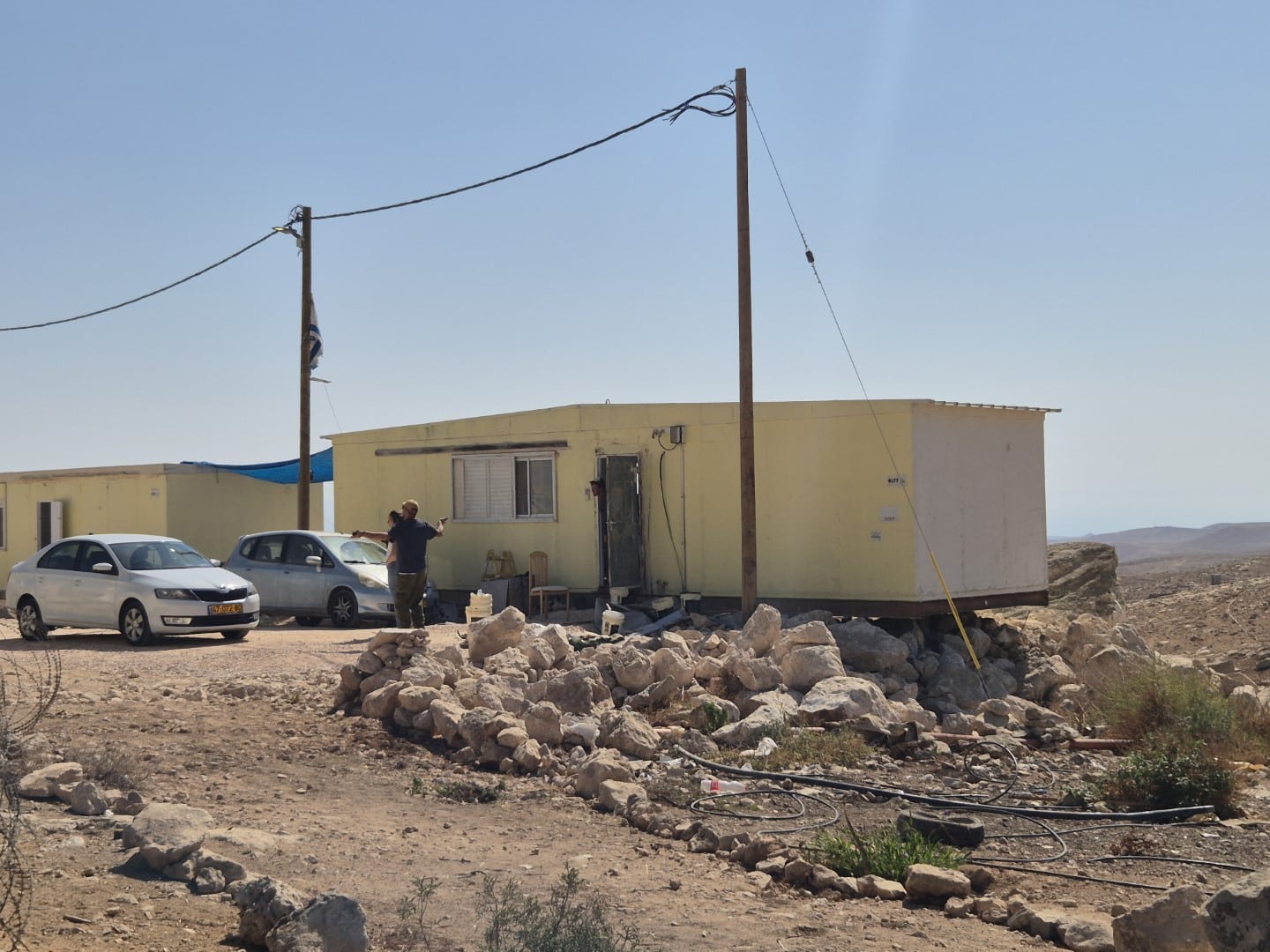
Illegal outpost established by Israeli settlers on Umm al-Khair land, Source: Peace Now
Entering into Umm al-Khair, it is impossible to not feel the imposition of the Israeli occupation on all fronts. The only way to enter the village is by a road the runs right through the Carmel settlement. The road is flanked by near two-metre-high fences, topped with barbed wire, with two settler militia guard posts at two points along it. Despite its creation only being in the 1980s, the settlement now dwarfs the village of Umm al-Khair and continues to grow through planning permission granted by the Israeli authorities as well as illegal outposts built on private Palestinian land.
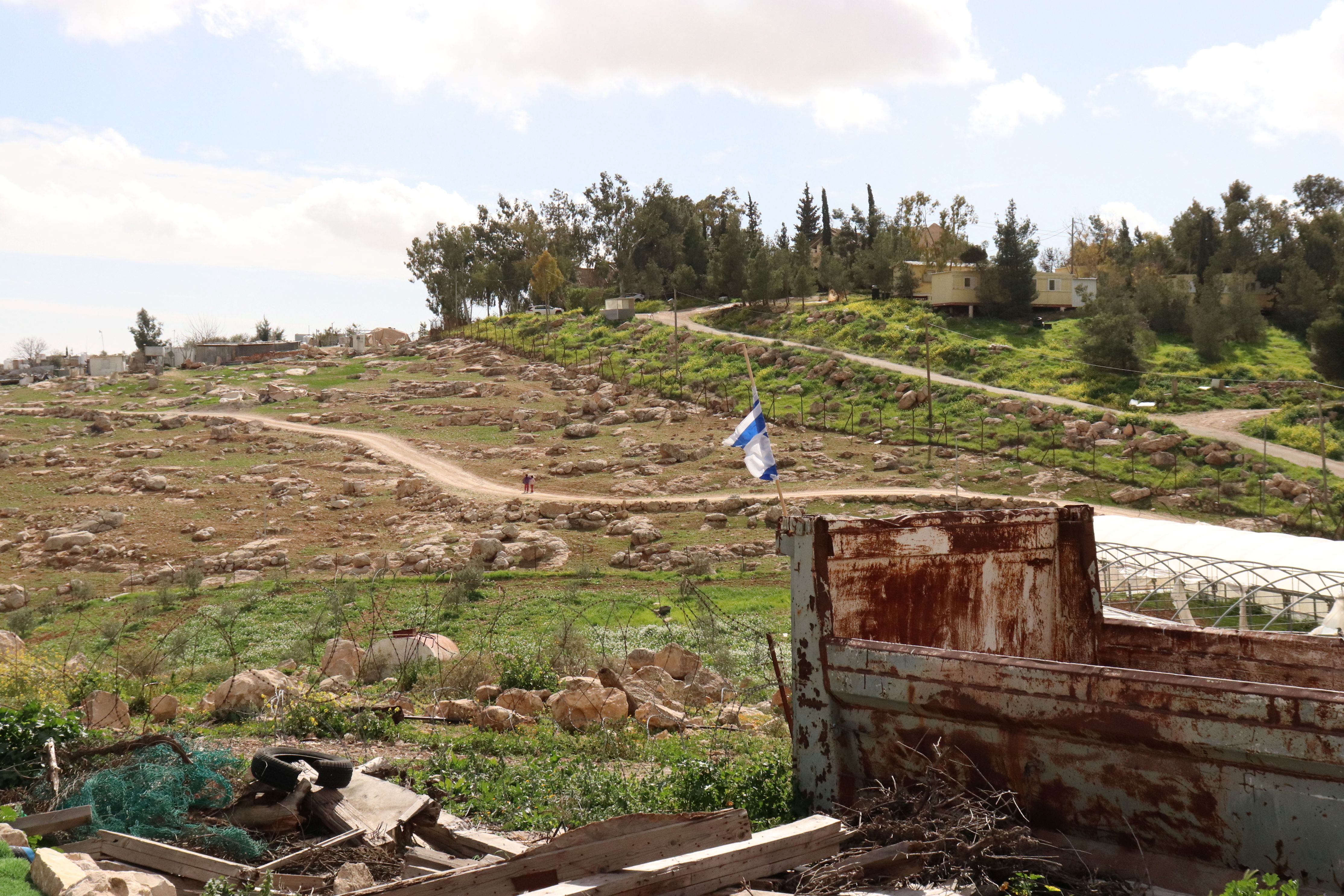
Umm al-Khair roads with barbed wire and Israeli flag
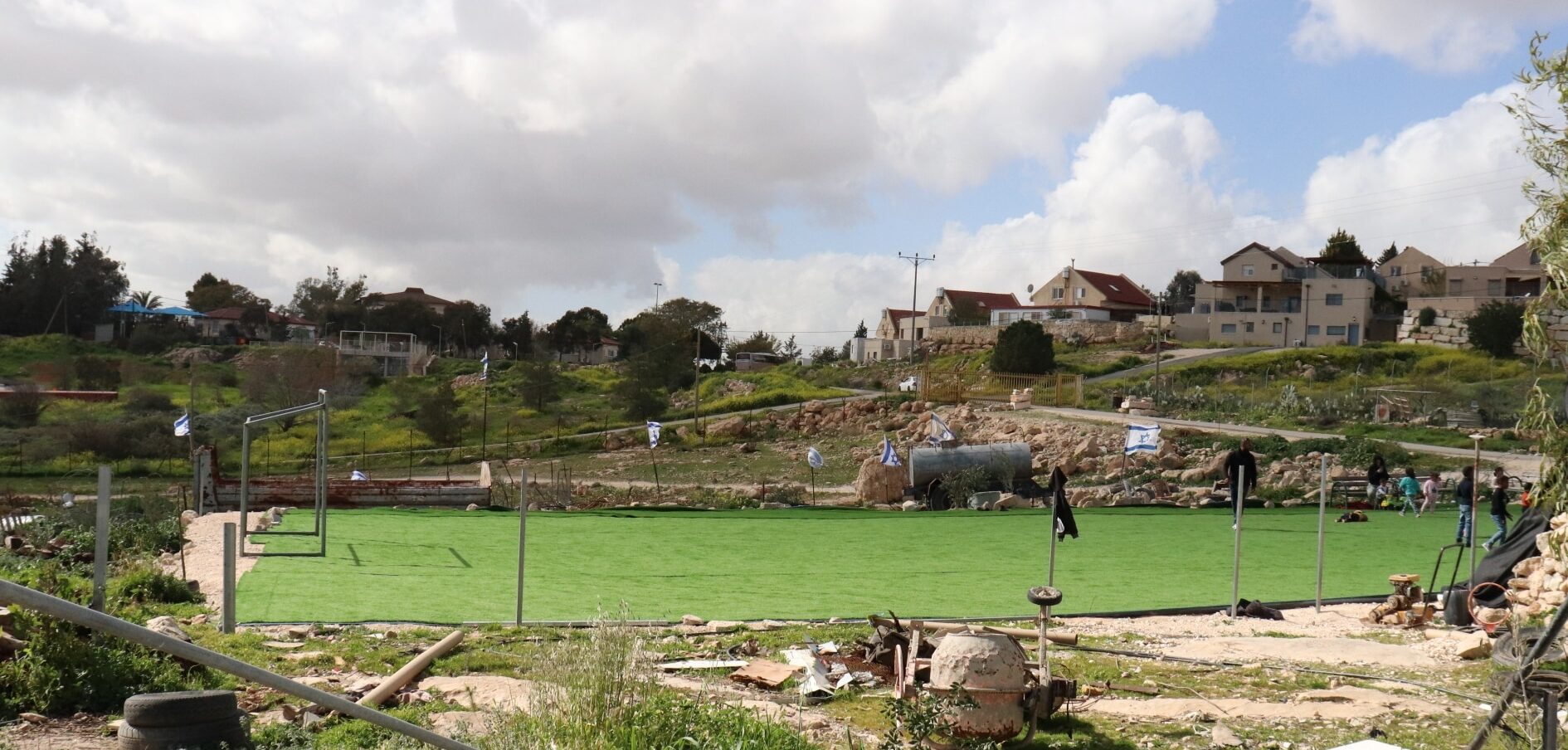
Football pitch and houses of Carmel Israeli settlement in background
What this means for the residents of Umm al-Khair is: perpetual harassment, violence and intimidation by settlers, struggles to maintain their agricultural livelihood, and more recently efforts aimed at stopping them from giving their children a space to play.
That day, as we were playing, a settler from the illegal Israeli outpost that borders the pitch walked past pushing a pram, with a semi-automatic assault rifle slung over his shoulder.
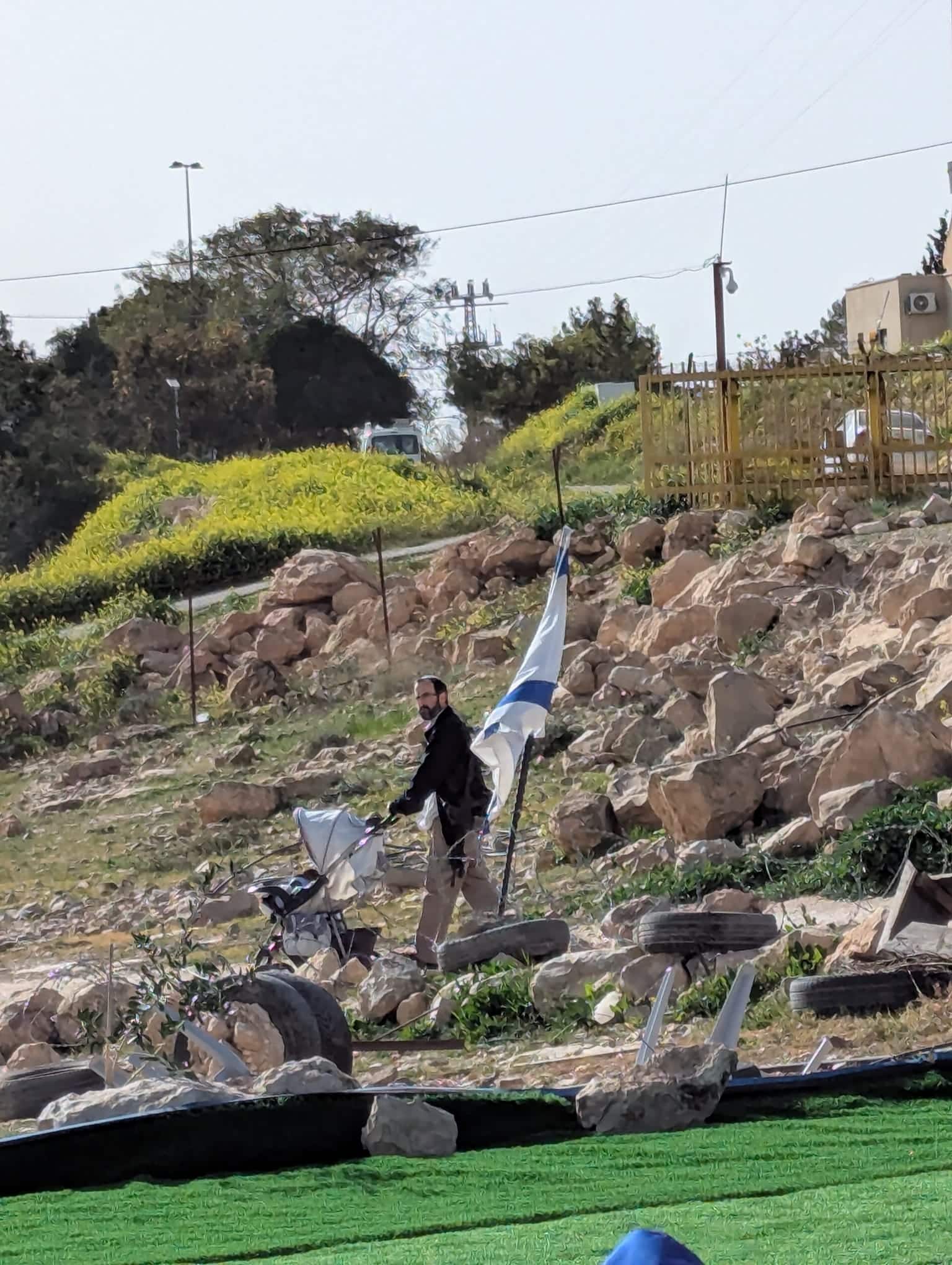
Israeli settler from the Carmel illegal settlement walking with pram and rifle
My instinctive reaction was fear, but as I looked around at the Palestinian children and adults present, what struck me was the lack of fear, surprise, or reaction in any real sense. The children kept playing, as if nothing was happening. I asked Khalil and he told me:
“This intimidation is every day, we cannot be scared by this every day.”
Khalil Hathaleen, community leader of Umm al-Khair
For the past 20 years, a rectangle of about a tenth of an acre, covered only in rocks, stones and dirt, represented the only viable open space for children to play but was far from ideal:
“We had so many cuts and scrapes and broken bones [from the ground]. The children would never stop playing, they are children. We had to make something safe for them.”
Khalil Hathaleen
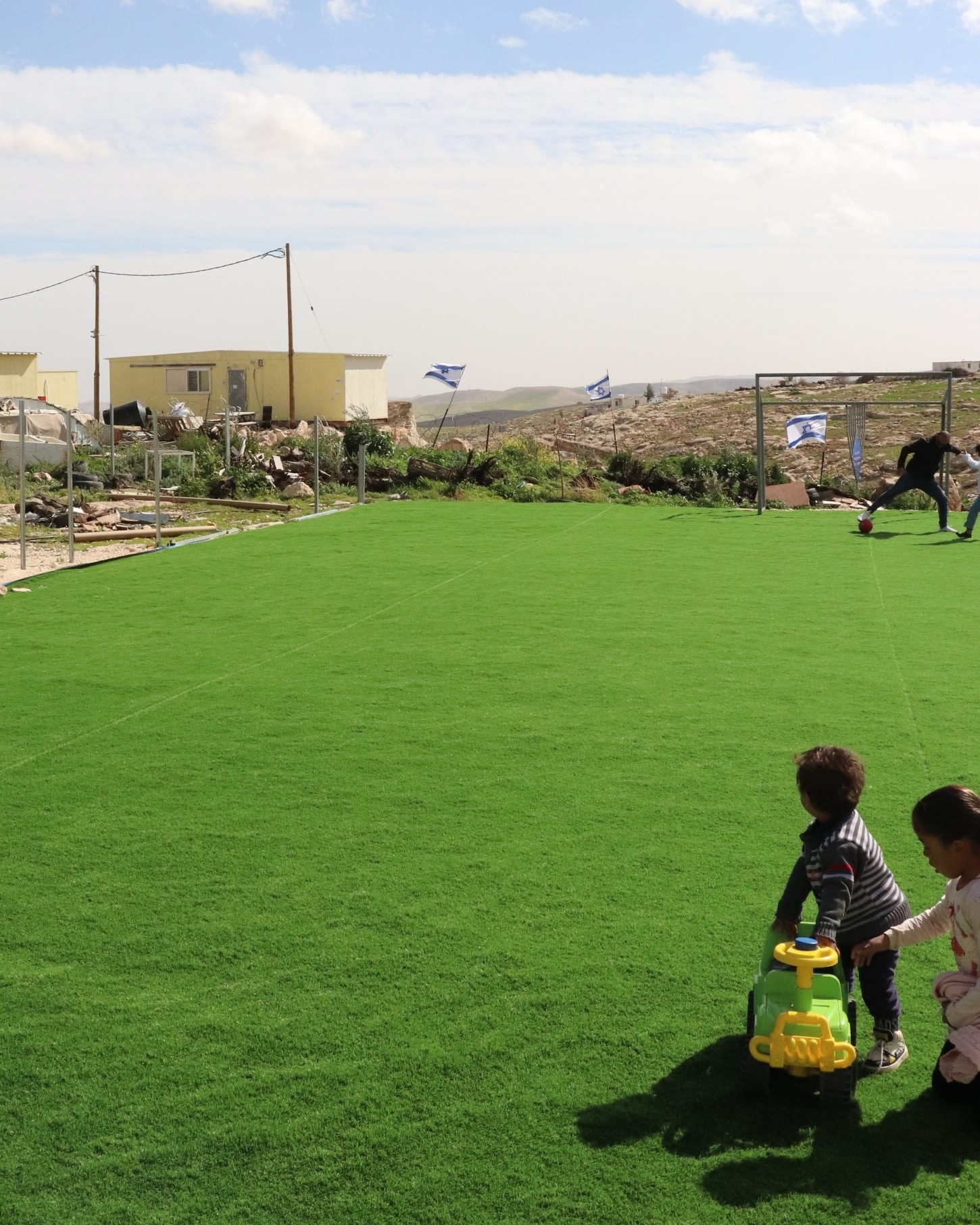
Children playing on the newly laid pitch
In February 2026, Khalil and the community wanted to turn this space into a real, safe football pitch for the children. However, the day the community gathered to celebrate the laying of the grass and the memorialising of Awdah, armed settlers from the Carmel settlement and the outpost tried to stop the community from rolling out the green carpet. They threatened the community and placed large boulders in the way. During the night, settlers then took over another strip of privately owned Palestinian land just metres away and carved a road connecting the illegal outpost to the main settlement road to Carmel, cutting straight through the heart of the village. Finally, settlers adorned the nascent pitch with dozens of Israeli flags and symbols. The Israeli army was present but did not stop the settlers.
I spoke to another community leader about this event, Eid Hathaleen (not related to Khalil or Awdah), and he said that;
“The illegal settlement is given more right to exist than the lands we own and have lived on for generations. We just want equality. We want to be treated with the same rights as the Israelis who live in those houses there, and for our children to have them too.”
Eid Hathaleen, community leader
Khalil told us that, all these actions were and remain acknowledged as illegal by the Israeli Civil Administration. However, the outpost, the road, rocks and flags have remained, and instead a demolition order has been placed on the football pitch.
In the illegally occupied West Bank, demolition orders are given to Palestinian families, communities and businesses by the Israeli authorities to notify them that their building was built without the relevant Israeli permit and therefore is liable to demolition. Demolition orders are rooted in an unequal and punitive planning system. According to Israeli human rights group, B’Tselem:
“Israel exploits the law to prevent development, thwart planning and carry out demolitions. This is part of a broader political agenda to maximize the use of West Bank resources for Israeli needs, while minimizing the land reserves available to Palestinians.”
Since October 2023, 282 applications for building permits have been submitted by Palestinians to their Israeli occupiers, and not a single one was approved. In Umm al-Khair alone, according to the United Nations, in the past 15 years Israel has demolished 56 structures in the village, 14 of them in the past 18 months. Moreover, a large amount of the village lives under the constant threat of demolition, as Israel considers almost all of the buildings in the village to be illegal even though the community and many of the structures predate the permit system (which are denied when they try).
According to Israeli settler groups, they pushed the Israeli authorities to place the pitch under a demolition order because “the installation of the synthetic grass was illegal” and “threatened” the settlement of Carmel, which lies just several dozen meters away.”
The intimidation of the residents of Umm al-Khair continues; in early May 2026, a large group of settlers from Carmel stormed the village and occupied the children’s playground. They also attempted to raid the residents’ homes in the village. The week before that, settlers placed razor wire blocking the route used by children to reach school, and when children tried to pass, residents said soldiers fired teargas and stun grenades.
The widow of Awdah, Hanady Hathaleen, writes:
“In Umm al-Khair, the state’s violence is not only aimed at the stone, but also at the dream… even the dreams of children are not spared.”
Handay Hathaleen
When talking to Khalil, about his hopes for the pitch and for the village, he told me:
“All I want is for our children to have a safe space to play, free from violence, military and intimidation.”
Khalil Hathaleen
Take action
-
Email your elected representative to demand they stop trading with illegal settlements as a first step to end support for Israel’s illegal occupation which prevents children from playing: Send the email – UK ; Send the email – Ireland.
-
Donate: The need for solidarity and accompaniment is more important than ever. Your support helps us maintain a solidarity presence in Palestine and Israel — witnessing human rights abuses and walking alongside communities under threat.
What does international law say?