

Abu Said is all smiles as he greets us on the veranda of his home, at the far edge of Jericho, in the south of the Jordan Valley. He is the leader of a Bedouin community of forty families, dispersed up and down the rocky mountain face on which they live.
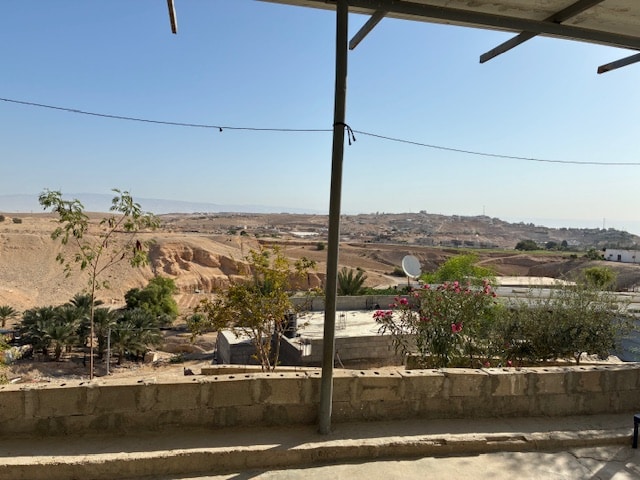
View from veranda of Abu Said’s house, Jericho, occupied West Bank
His house, also home to his sheep and goats, is a one-storey building with metal rods protruding from the roof. Abu Said has always wanted to build a second floor for his grown-up children and their families. This is the Palestinian way. Neighbours who live just a hundred yards down the road can build a second floor if they want. But they live in Area A.
Under the 1993 and 1995 Oslo Accords, the West Bank was divided into three areas. Area A, administered by the Palestinian Authority (PA), Area B under joint PA and Israeli military control and Area C, comprising 62% of the West Bank which was placed under complete Israeli military and civil control. In Area C, even the erection of a tarpaulin to keep the winter rain off the sheep requires special planning permission.
Almost all the Bedouin communities in the Jordan Valley live in Area C. A lack of clarity about where one Area ends and another begins adds to the frustration of those affected, including Abu Said and his community:
‘We don’t know where is Area A, and where is Area C.’
Abu Said, Jericho
Abu Said has good reason to believe that an application to build a second floor on his house in Area C will be refused.
‘They [the Israeli authorities] decide whatever they want. They want to take everything.’
Abu Said
Data provided by the Israel’s Civil Administration shows that between 2016 and 2020, 99.1% of Palestinian requests for building permits were rejected. Israeli peace movement Peace Now contrasts this with the construction of 7,000 new houses beginning in same period, in Israeli-only settlements considered illegal under international law. From his house he can see one of these illegal settlements – Mevo’ot Yeriho – just a few hundred meters away. There is a bulldozer at work inside the settlement, as we speak. Some 465,000 Israeli settlers currently live in hundreds of illegal settlements in the West Bank, concentrated in Area C. In December 2025, the Israeli government approved 11 new illegal settlements for construction in a move described by Smotrich aimed at destroyed a Palestinian state.

View from Abu Said to the illegal Me’evot Yericho settlement
But for Abu Said more troubling still is the rise in settler violence. His community is visited most days by settlers insisting that they must leave. The night before settlers had come to his home at 1, and again at 4 am.
‘It is stressful living this life.’ he says, pointing to an iron bed on the verandah: ‘I sleep outside watching. Last night we did not sleep at all.’
Abu Said
The UN Office for the Coordination of Humanitarian Affairs reported, as far back as September 2003, that a combination of settler violence:
‘Together with Palestinians’ inability to obtain approvals to build, demolitions, evictions, movement restrictions and ongoing settlement expansion create a coercive environment that contributes to displacement that may amount to forcible transfer, a grave breach of the Fourth Geneva Convention.’
United Nations
Abu Said tells us what we have heard in every Bedouin community we have visited in the Jordan Valley, that since October 2023 the regularity and severity of violent settler attacks have become much worse.
Before 7 October the community grazed its sheep on a large area of uncultivated land surrounding the village. Now settlers, backed up by Israeli police and military, forbid the Bedouin from leaving their homes with their sheep. This practise, widespread across the whole of the West Bank, has been well documented by Israeli human rights organisation Peace Now. Deprived of the possibility of grazing Abu Said is unable to afford the fodder his home-bound sheep need:
‘I have to sell sheep, to buy food for the others.’
Abu Said
His flock has reduced in size from 200 to 50.
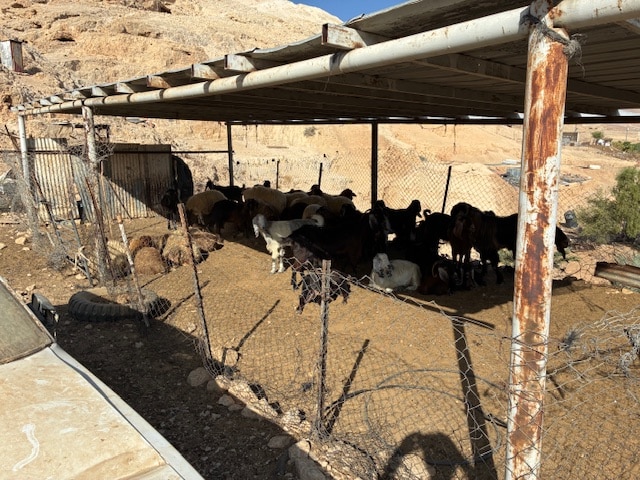
Abu Said’s depleted flock of sheep
Faced with this increase in settler attacks, and a failure of the police to investigate the perpetrators, Bedouin communities like Abu Said’s fear for their future. Israeli Human Rights organisation Yesh Din has been monitoring police investigations of Israeli (mostly settler-perpetrated) human rights violations against Palestinians in the West Bank since 2005. Of the 1,701 investigations reported, 94% ended without any action and only 3% resulted in a conviction. In January 2025 Yesh Din reported:
‘Over the past two years, since the establishment of the government, the scope and severity of settler violence have intensified significantly. The government’s stated intention to expand the settlement enterprise in the West Bank, measures amounting to de facto annexation of the West Bank, and Itamar Ben Gvir’s appointment as the minister in charge of the Israel Police have sent a clear message that the Government of Israel supports and backs organized settler violence and considers it a means for achieving its goals.’
Yesh Din
In May 2025, the Israeli cabinet voted to resume land registration in Area C of the occupied West Bank, a move the United Nations warned:
‘Appears to be the latest tool used by Israel to acquire Palestinian land and consolidate the unlawful annexation of the West Bank.’
United Nations
Peace Now called it:
‘A mega theft of Palestinian lands [which] will result in the transfer of ownership of the vast majority of Area C to the state, and the Palestinians will have no practical way to realize their ownership rights.’
Peace Now
In September, Israeli cabinet minister Bezalel Smotrich argued publicly for annexation of the whole of the occupied West Bank:
‘The time has come to apply Israeli sovereignty to Judea and Samaria.’
Israeli government
Somehow Abu Said remains resilient in the face of intense and unrelenting pressure aimed at forcing his community to leave – as happened in July 2025 to the 13 remaining families in the nearby community of Mujarrat East (60-70 families in 2020).
But even if the settlers get their way,
‘It will not be the end of the story’ says Abu Said quoting an Arabic proverb which translates ‘He who perpetrates injustice will not remain.’
As we leave a group of Bedouin women have gathered in the compound. They have erected a poster and are beginning a workshop. The poster is in English: ‘Improving the capacity of women to live a healthy and violence free life in Jericho’. The struggle to live a purposeful life amidst the unrelenting pressures of the occupation goes on.
Take action
-
Email your elected representative to demand that our government takes action to stop settlement expansion and annexation:
The need for solidarity and accompaniment is more important than ever. We can’t do this without you. Your support helps us maintain a solidarity presence in Palestine and Israel — witnessing human rights abuses and walking alongside communities under threat. Donate today.
What does international law say?